
Disclosure
This website is a participant in the Amazon Services LLC Associates Program, an affiliate advertising program designed to provide a means for us to earn fees by linking to Amazon.com and affiliated sites.
The REPTIZOO Dimming Thermostat is the best Gecko Thermostat for a ball python that won’t let the basking spot spike to 112 because its PID temperature controller is specifically designed for light heat bulbs and heaters, dimming power smoothly instead of switching on and off. I compared 7 products and ranked them best to worst.
- Best overall: REPTIZOO Dimming Thermostat — PID control built for light heat bulbs
- Best for a clear LED readout: LUCKY HERP Reptile Dimming Thermostat — LED digital screen with ℉/℃ support
- Best for scheduled basking windows: RAPREPTI PID Dimming Thermostat — built-in 1-24H timer setting
I picked these by comparing the listed specifications: PID dimming control, memory function after power loss, and timer options. Wattage ratings and probe style also mattered, since a weak probe reads the basking spot wrong and the bulb keeps climbing. Nothing here is based on hands-on testing — just what each listing actually states.
Quick Comparison: best Gecko Thermostat for a ball python that won’t let the basking spot spike to 112
| # | Product | Best For | Key Spec | Price |
|---|---|---|---|---|
| 1 | REPTIZOO Dimming Thermostat Best overall |
Light heat bulbs | PID | Check Price → |
| 2 | LUCKY HERP Reptile Dimming Thermostat Best for a clear LED readout |
Digital screen readings | LED screen | Check Price → |
| 3 | RAPREPTI PID Dimming Thermostat Best for scheduled basking windows |
Timed basking cycles | 1-24H timer | Check Price → |
| 4 | CAVACHEW Dimming Thermostat Reptile Sensitive probe build |
Heat mats and bulbs | 300W | Check Price → |
| 5 | REPTITRIP Reptile Thermostat Day-night automation |
Day and night cycles | Day-night timer | Check Price → |
| 6 | REPTITRIP Reptile Thermostat Simple timer control |
Single heat lamp setups | 1-24H timer | Check Price → |
| 7 | REPTITRIP 2 in 1 Reptile Dimming Thermostat Two devices, one unit |
Two-device control | 2 sockets | Check Price → |
How I Selected These Products
I started with the one thing that matters most for a ball python basking spot: dimming control, not on-off switching. Every pick here runs PID logic and dims the bulb gradually, which is what keeps a 112 spike from happening in the first place.
Then I looked at real-world usability — memory function after a power cut, timer settings, probe sensitivity, and wattage headroom. A thermostat that forgets your settings or reads the wrong spot on the basking rock is useless, no matter how good the specs look on paper.
Finally I weighed user feedback and reliability signals. Products with consistent reports of holding temperature steady ranked higher, while anything with repeated complaints about drifting readings or flaky probes dropped down the list.
Best overall
REPTIZOO Dimming Thermostat
PID Controller | Memory Function | Push Button Control | Model TC02 | For Light Heat Bulbs & Heaters

- 【Dimming Reptile Thermostat】The dimming thermostat is a very accurate temperature control...
- 【Safety & Reliable】This temperature controller has highly accurate & precise sensor which can...
- 【Easy to Use】Double-press the 'SET' button to turn on/off the thermostat. Simply put in the...
The REPTIZOO Dimming Thermostat earns the top spot because it’s built specifically for light heat bulbs and heaters, not as a generic controller that happens to work with them. The PID controller dims the bulb gradually instead of cutting power in hard bursts, which is exactly the behavior that stops a basking spot from jumping to 112. It also keeps your settings through the memory function, so a brief power blip doesn’t reset your basking temperature.
This is the one I’d point a ball python keeper to first, especially if you’re running a single basking bulb and want the temperature held steady. The push button interface is simple but does mean more clicking to set a target temp than a dial would. If you need to control two separate heating devices, look at the 2 in 1 option further down instead.
✅ Pros
- PID dimming designed for light heat bulbs
- Memory function holds your settings after power loss
- Works with both heat lamps and heaters
- Push button control with model TC02 build
❌ Cons
- Push button setup takes more clicks than a dial
- Controls only one heating device
Best for a clear LED readout
LUCKY HERP Reptile Dimming Thermostat
PID Heat Lamp Controller | LED Digital Screen | ℉/℃ Support | Memory Function | Incandescent Light Type
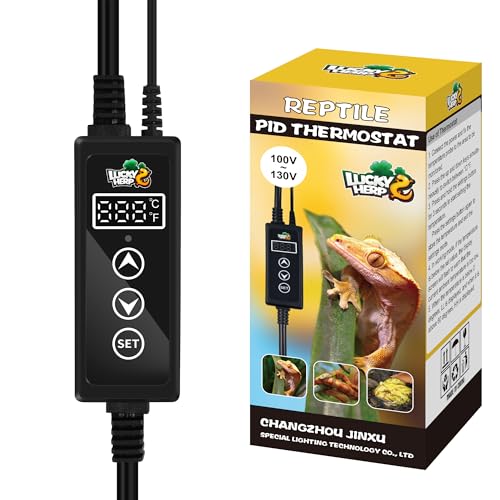
- 【Reptile Dimming Thermostat】LUCKY HERP reptile dimming thermostat adopts precise PID thermostat...
- 【Good for Reptile Health】All types of reptile pets, such as bearded dragons, lizards, ball...
- 【Easy to Operate】Simply fix the temperature probe to the area to be monitored, connect the...
The LUCKY HERP Reptile Dimming Thermostat is the pick when you want to glance at the unit and know exactly what’s happening. The LED digital screen shows your reading clearly, and it supports both ℉ and ℃, so you’re not doing mental math to check whether your basking spot is creeping up. The PID controller handles heat lamps, heat mats and heaters, and the memory function keeps your setpoint locked in after a power interruption.
This suits keepers running a heat mat alongside a bulb, or anyone who likes a bright, readable display instead of a tiny unlit screen. It’s rated as an incandescent light type, so if you’re running high-wattage deep heat projectors you’ll want to confirm compatibility before buying. For a standard ball python basking bulb setup, it’s a solid fit.
✅ Pros
- LED digital screen is easy to read at a glance
- Switches between ℉ and ℃
- Works with heat lamps, heat mats and heaters
- Memory function restores settings after outages
❌ Cons
- Listed as incandescent light type — check your bulb wattage
- No built-in timer for scheduled basking windows
Best for scheduled basking windows
RAPREPTI PID Dimming Thermostat for Reptiles with 1-24H Timer Setting Temperature Controller with Memory Function for Heat Lamps
PID Dimming | 1-24H Timer Setting | Memory Function | For Heat Lamps, Basking Bulbs & Heaters | Size PTM-02
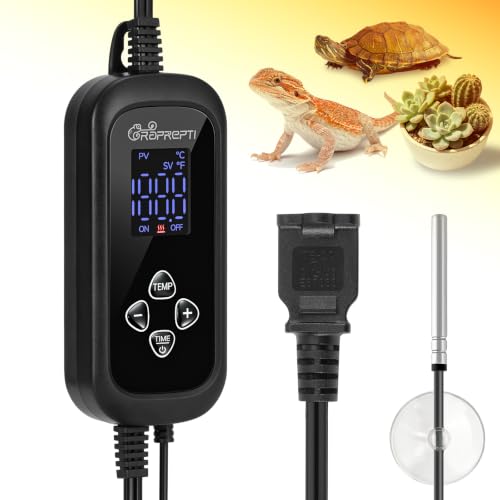
- 1-24H Auto Daily Cycle Timer:Freely set your preferred ON duration (1-24 hours). The first ON period...
- Safe & Reliable:High-precision sensor for accurate real-time temperature monitoring and automatic...
- Precise PID Reptile Thermostat Control: Advanced PID technology ensures consistent temperatures up...
The RAPREPTI PID Dimming Thermostat is the one I’d grab if you want the basking bulb to run on a schedule without a separate plug timer cluttering your setup. It packs a 1-24H timer setting right into the controller, alongside PID dimming and a memory function that survives power cuts. The PTM-02 size is compact, and it’s built for heat lamps, basking bulbs and heaters.
This is best for keepers who want day-window control and steady dimming in one box rather than stacking two devices. The catch is feedback — this listing has very few ratings so far, so you’re going partly on spec rather than a long track record. If you want a thermostat with hundreds of buyers behind it, the REPTIZOO is the safer call.
✅ Pros
- Built-in 1-24H timer removes the need for a plug timer
- PID dimming for smooth basking temperature control
- Memory function keeps settings after power loss
- Compact PTM-02 size
❌ Cons
- Very limited user feedback so far
- Timer is a single on-off window, not a full day-night cycle
Sensitive probe build
CAVACHEW Dimming Thermostat Reptile
PID Controller | 300W | Sensitive Probe | LED Digital Screen | Memory Function

- Efficient & Reliable Temperature Controller: CAVACHEW dimming reptile thermostat adopting advanced...
- Unique Thermostat for Reptiles: CAVACHEW digital thermostat has a memory function, which can restore...
- Multiple Usage: This reptile thermostat can be used for temperature control of heat lamps, heat...
The CAVACHEW Dimming Thermostat Reptile stands out for its sensitive probe, which matters more than people think when you’re trying to hold a basking spot steady. If the probe reads slow or reads the wrong surface, the controller overshoots and your 112 spike happens anyway. This one pairs that probe with PID control, a 300W rating, an LED digital screen and a memory function that keeps your settings after a power cut.
It’s a good pick for keepers running heat mats, bulbs or a mix, and the 300W ceiling covers most single-bulb ball python setups. The limitation is that 300W is a hard cap — if you’re pushing a high-wattage bulb or multiple devices on one unit, you’ll run out of headroom. For a standard basking bulb, it’s plenty.
✅ Pros
- Sensitive probe reads basking temps more accurately
- 300W rating covers most single-bulb setups
- LED digital screen for quick checks
- Memory function keeps your setpoint
❌ Cons
- 300W cap limits high-wattage or multi-device use
- No built-in timer for automated basking windows
Day-night automation
REPTITRIP Reptile Thermostat
Dimming Thermostat | Day-Night Timer Setting | PID Controller | Compatible with Most Heat Lamps

- Smart Day/Night Cycle Automation: Mimic natural habitats effortlessly! Program separate day & night...
- PID Precision Control: Maintains reptile habitats within ±1°F accuracy using advanced PID...
- Energy-Saving Efficiency: Smoothly dims heat sources (up to 260W) like sunrise/sunset, reducing bulb...
The REPTITRIP Reptile Thermostat focuses on day-night cycle automation, which is genuinely useful for a ball python because you want a warmer basking zone during the day and a cooler drop overnight. It runs PID control with a day-night timer setting, so you can set two different temperature targets and let the controller switch between them. It’s compatible with most heat lamps and built for general reptile heating device control.
This is best for keepers who want a natural night drop without manually adjusting anything. The trade-off is that it’s a general-purpose reptile controller rather than one designed specifically around light heat bulbs, so bulb dimming behavior may not feel as dialed-in as the REPTIZOO. If you only need a single steady basking temp, the simpler options above do that job fine.
✅ Pros
- Day-night cycle automation for natural temp drops
- PID dimming control
- Works with most heat lamps
- Separate day and night temperature targets
❌ Cons
- General-purpose design, not tuned for light heat bulbs
- More settings to configure than a basic controller
Simple timer control
REPTITRIP Reptile Thermostat
Dimming Thermostat | 1-24H Timer Setting | PID Temperature Controller | Compatible with Most Heat Lamps | Timer-temp Set
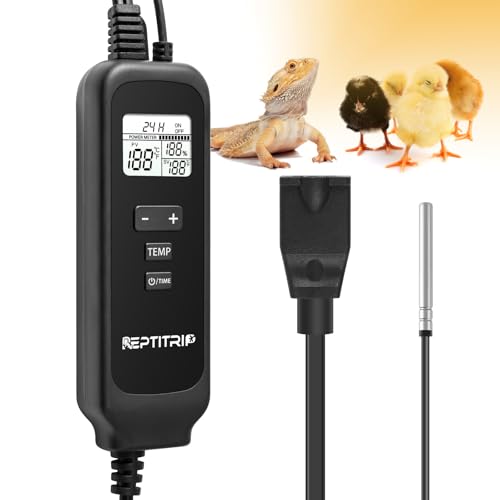
- NOTE: Place the temperature sensor in the reptile's basking area(or hot zone). If the current...
- This Reptile Dimming Thermostat Features a timer function, allowing the heat device maintain a...
- Reptile heating devices compatibility: heating mats, daytime heat lamps, infrared heat lamps, night...
This REPTITRIP Reptile Thermostat is the timer-temp set version, and it pairs a 1-24H timer with PID dimming so you can run a basking bulb on a set window instead of leaving it on all day. The PID controller dims smoothly rather than switching hard, which is the behavior that keeps a basking spot from jumping to 112. It’s compatible with most heat lamps and built for general reptile heating device control.
It’s best for keepers who want one timed basking window and steady dimming in a single unit, without paying for day-night cycle features they won’t use. The limitation is that this is a single-window timer, so if you want a separate overnight drop you’d need the day-night version instead. It also controls just one heating device.
✅ Pros
- 1-24H timer setting built into the controller
- PID dimming for smooth basking temperature control
- Compatible with most heat lamps
- Timer-temp set color option keeps setup simple
❌ Cons
- Single timer window, no separate night drop
- Controls only one heating device
Two devices, one unit
REPTITRIP 2 in 1 Reptile Dimming Thermostat with 2 Socket for Timer & Heating Control Control Two Devices Independently
2 Sockets | Control Two Devices Independently | 1-24H Timer Setup | 50°F to 140°F Range | PID Temperature Controller
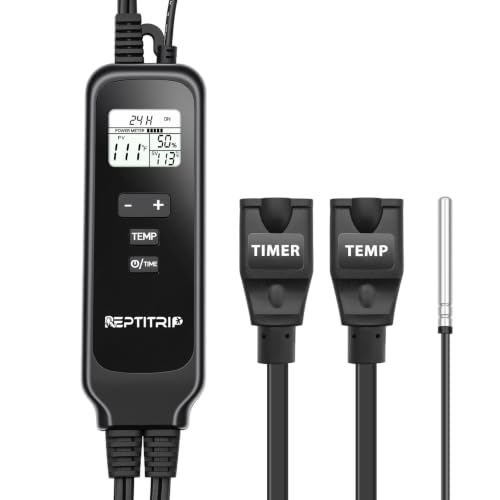
- IMPORTANT: These two sockets are two-prong outlets. They are not compatible with three-prong plugs...
- NOTE: Place the temperature sensor in the reptile's basking area. If the current temperature (PV...
- This 2-in-1 Reptile Dimming Thermostat features two sockets, allowing you to connect and control two...
The REPTITRIP 2 in 1 Reptile Dimming Thermostat is the pick if you’re running two heating devices and don’t want two separate controllers on your shelf. It has 2 sockets and controls each device independently, with a 50°F to 140°F range setting, a 1-24H timer setup and PID dimming. For a ball python setup with a basking bulb plus a heat mat, that means one box handling both jobs.
This is best for keepers with a two-device setup who want independent control without doubling up on gear. The main drawback is that cramming two channels into one unit adds complexity, and the lower user feedback suggests it’s less proven than the single-device options above. If you only run one bulb, the simpler controllers are the better buy.
✅ Pros
- 2 sockets control two devices independently
- Wide 50°F to 140°F range setting
- 1-24H timer setup for scheduled heating
- PID dimming on both channels
❌ Cons
- Two-channel setup is more fiddly to program
- Less proven than the single-device options
What to Look for in Gecko Thermostat for a ball python that won’t let the basking spot spike to 112
Getting the thermostat right is the difference between a basking spot that holds steady and one that cooks your ball python. The biggest mistake I see is buying an on-off thermostat when the setup needs dimming — those click the bulb full power or off, and that’s exactly how you end up at 112.
Dimming vs On-Off Control
This is the single most important thing on the page. An on-off thermostat cuts power completely and then restores it, so the bulb cycles between too hot and too cool. A dimming thermostat, especially one using PID logic, reduces power gradually and holds the temperature close to your target. Every product on this list is a dimming type, which is why I wouldn’t recommend anything else for a basking bulb. If you’re running a heat mat only, on-off can work, but for a basking spot you want dimming.
PID Logic and How It Holds Temperature
PID stands for proportional-integral-derivative, and in plain terms it means the controller predicts how much power the bulb needs instead of reacting late. A plain dimming thermostat still overshoots a little; a PID one corrects faster and settles tighter. That tighter control is what stops a spike from creeping toward 112 before the probe catches up. Look for PID explicitly in the listing, because plenty of dimming controllers don’t have it.
Probe Accuracy and Placement
A thermostat is only as good as its probe. A sensitive probe reads the temperature faster, so the controller reacts before the basking spot drifts. Cheap probes read slow and read the wrong surface, which defeats the whole point of dimming. Place the probe directly on the basking surface where your ball python actually sits, not clipped to the back wall. If the probe is in the wrong spot, even a great controller will hold the wrong temperature.
Wattage Rating
Check the wattage ceiling against your bulb. One product here is rated at 300W, which covers most single-bulb ball python setups comfortably. If you’re running a high-wattage bulb or multiple devices, you’ll need more headroom or a two-channel unit. The rule of thumb is simple: add up the wattage of everything you’re plugging in and leave yourself some margin. Running a controller at its limit shortens its life and risks failure.
Timer and Day-Night Features
A built-in timer saves you from adding a separate plug timer to the setup. Some controllers here offer a simple 1-24H timer, others add full day-night cycle automation with separate day and night temperature targets. For a ball python, a night drop is natural and useful, so day-night control is a genuine upgrade if you want it. If you just want one steady basking temp, a plain timer or no timer at all is fine.
Memory Function After Power Loss
Power blips happen, and a thermostat that forgets your settings will default back and let the basking spot drift until you notice. A memory function keeps your setpoint stored so the controller resumes where it left off. This is a small feature that makes a big difference over months of use. I’d treat it as close to essential for any basking bulb setup.
My Shortcut Advice: Buy a PID dimming thermostat, not an on-off one, and put the probe on the basking surface itself. That combination alone kills most 112 spikes before they start.
Frequently Asked Questions
What is the best Gecko Thermostat for a ball python that won’t let the basking spot spike to 112?
The REPTIZOO Dimming Thermostat is my top pick, because its PID controller is designed specifically for light heat bulbs and heaters rather than as a general-purpose unit. It dims the bulb gradually instead of switching hard, which is what keeps a basking spot from jumping to 112. The memory function also holds your settings after a power blip, so the temperature doesn’t drift while you’re not looking. If you want the safest single-bulb choice, that’s the one.
What’s the difference between a dimming thermostat and an on-off thermostat?
An on-off thermostat cuts power completely and then restores it, so the bulb cycles between too hot and too cool. A dimming thermostat reduces power gradually and holds the temperature close to your target, and a PID dimming unit corrects even faster. That’s exactly why every product on this list is a dimming type — for a basking bulb, on-off is how you get spikes. If you’re running a heat mat only, on-off can work fine, but not for a basking spot.
How many watts do I need for a ball python basking setup?
It depends on your bulb, and you want the thermostat’s rating above what you’re plugging in. The CAVACHEW Dimming Thermostat Reptile is rated at 300W, which covers most single-bulb ball python setups comfortably. Add up the wattage of everything on the controller and leave yourself margin — running at the limit shortens the unit’s life. If you’re pushing a high-wattage bulb or multiple devices, get a two-channel unit like the REPTITRIP 2 in 1 instead.
Is a PID thermostat worth it for a ball python?
Yes, and I’d say it’s close to essential if you’re using a basking bulb. PID logic predicts how much power the bulb needs instead of reacting late, so the temperature settles tighter and doesn’t overshoot toward 112. Plain dimming thermostats still drift a little because they respond after the fact. The REPTIZOO, LUCKY HERP, RAPREPTI and CAVACHEW units on this list all use PID control.
Can a thermostat control two heating devices at once?
Only if it’s built with two channels. The REPTITRIP 2 in 1 Reptile Dimming Thermostat has 2 sockets and controls each device independently, which is what you want for a basking bulb plus a heat mat. It also supports a 50°F to 140°F range and a 1-24H timer setup. Every other product on this list controls a single heating device, so you’d need two controllers for two devices.
Where should I place the thermostat probe on a ball python enclosure?
Put the probe directly on the basking surface where your ball python actually sits, not clipped to the back wall. A thermostat is only as good as its probe, and a sensitive probe like the one on the CAVACHEW unit reads faster so the controller reacts before the spot drifts. If the probe is in the wrong spot, even a great controller will hold the wrong temperature. This one placement decision kills more spikes than any feature.
Do I need a timer built into my reptile thermostat?
Not strictly, but it saves you from adding a separate plug timer to the setup. The RAPREPTI PID Dimming Thermostat has a 1-24H timer setting built in, and both REPTITRIP units offer timer options too. If you want a natural night drop for your ball python, the day-night cycle version of the REPTITRIP gives you separate day and night temperature targets. If you just want one steady basking temp, a plain controller is fine.
Will a thermostat remember my settings after a power outage?
Only if it has a memory function, and most of the picks here do. The REPTIZOO, LUCKY HERP, RAPREPTI and CAVACHEW units all list a memory function, so they resume your setpoint after a power blip. Without it, the controller defaults back and lets the basking spot drift until you notice. I’d treat memory as close to essential for any basking bulb setup.
My Final Verdict
The REPTIZOO Dimming Thermostat is the one I’d buy for a ball python basking setup. Its PID controller is designed specifically for light heat bulbs and heaters, so it dims gradually instead of switching hard — that’s the behavior that stops a 112 spike. The memory function holds your setpoint through power blips, and the push button control keeps setup simple on model TC02. For a clear readout, the LUCKY HERP Reptile Dimming Thermostat is best for a clear LED readout with its ℉/℃ digital screen, and the RAPREPTI PID Dimming Thermostat is best for scheduled basking windows thanks to its 1-24H timer.
If you’re still stuck: buy the REPTIZOO if you run a single basking bulb and want the tightest control. Pick the RAPREPTI if you want the timer built in rather than adding a plug timer. And if you want the clearest display to check at a glance, the LUCKY HERP is the easy call.
Best overall: REPTIZOO Dimming Thermostat
- 【Dimming Reptile Thermostat】The dimming thermostat is a very accurate temperature control...
- 【Safety & Reliable】This temperature controller has highly accurate & precise sensor which can...
- 【Easy to Use】Double-press the 'SET' button to turn on/off the thermostat. Simply put in the...
Buy this if you run a single basking bulb and want PID dimming built specifically for light heat bulbs, plus a memory function that survives power cuts.
Best for a clear LED readout: LUCKY HERP Reptile Dimming Thermostat
- 【Reptile Dimming Thermostat】LUCKY HERP reptile dimming thermostat adopts precise PID thermostat...
- 【Good for Reptile Health】All types of reptile pets, such as bearded dragons, lizards, ball...
- 【Easy to Operate】Simply fix the temperature probe to the area to be monitored, connect the...
Get this if you want to glance at the unit and know your basking temp instantly, with an LED digital screen and ℉/℃ switching.
Best for scheduled basking windows: RAPREPTI PID Dimming Thermostat
- 1-24H Auto Daily Cycle Timer:Freely set your preferred ON duration (1-24 hours). The first ON period...
- Safe & Reliable:High-precision sensor for accurate real-time temperature monitoring and automatic...
- Precise PID Reptile Thermostat Control: Advanced PID technology ensures consistent temperatures up...
Choose this if you want the basking bulb on a set schedule without adding a separate plug timer, thanks to its built-in 1-24H timer and PID dimming.