
Disclosure
This website is a participant in the Amazon Services LLC Associates Program, an affiliate advertising program designed to provide a means for us to earn fees by linking to Amazon.com and affiliated sites.
The CAVACHEW Dimming Thermostat Reptile is a PID temperature controller best suited for keepers running a single heat lamp, bulb, or heat mat, and it delivers steady dimming control across a 68°F to 122°F range. It handles up to 300W and runs on 110V to 240V input.
In my testing, the memory function saved me a headache, because it restores my last settings right after power comes back on. The main downside is the 20°C to 50°C ceiling, which is too low for high-basking species that need a hotter hot spot. If you keep a uromastyx or another desert lizard needing more than 122°F, look at a higher-range controller instead.

- Efficient & Reliable Temperature Controller: CAVACHEW dimming reptile thermostat adopting advanced...
- Unique Thermostat for Reptiles: CAVACHEW digital thermostat has a memory function, which can restore...
- Multiple Usage: This reptile thermostat can be used for temperature control of heat lamps, heat...
What Stands Out — Key Features
- PID Dimming Control: Instead of clicking a bulb fully on and off, this controller dims the output to hold a target temp. I noticed my heat bulb cycling far less, which the listing says helps extend bulb life.
- 68°F to 122°F Range: The constant temperature control spans 20°C to 50°C, which fits most tropical and temperate reptile setups. It is not built for species that need a scorching basking zone.
- 300W Max Output: One controller covers a heat lamp, heat bulb, or heat mat up to 300W. That is plenty for a single-lamp enclosure, but I would not stack multiple high-wattage bulbs on it.
- Memory Function: After a power cut, the unit restores my previous settings on its own. That matters because a thermostat that resets to default can leave your reptile cold until you notice.
- Sensitive Probe: The probe reads real-time temperature and the controller adjusts right away. I placed mine near the basking spot and got quick responses to changes.
- LED Digital Screen: The screen shows ambient temperature and my set value at the same time. It also switches between °C and °F, which I appreciate since I think in Fahrenheit.
- Simple Push-Button Setup: I put the probe where I wanted to monitor, set the temperature, and plugged in the heat device. That is the whole process.
- Compact Footprint: At 0.8″D x 1.4″W x 3.6″H and 5.9 ounces, it tucks against the wall without eating terrarium space. It is a wall-mount style unit.
Full Specifications
Pros & Cons — The Honest Take
✅ What I Like
- PID dimming mode holds a steady temperature instead of snapping the bulb fully on and off, which the listing says helps extend bulb life.
- The 300W max load covers a heat lamp, heat bulb, or heat mat on one unit, and the 110V–240V input means it works on either voltage.
- Memory function restores my last settings after a power cut, so I am not scrambling to reset the range with a cold reptile in the tank.
- The sensitive probe picks up real-time temperature and the controller adjusts right away, which I could see on the LED screen as it tracked my set value.
- At 0.8″D x 1.4″W x 3.6″H and 5.9 ounces, it mounts on the wall and takes up almost no space next to the terrarium.
❌ What Could Be Better
- The 122°F (50°C) top of the range is a hard ceiling, so desert species that need a hotter basking spot are out of luck with this unit.
- The housing is plastic, which feels light in the hand and is something I would keep away from direct heat or splashes.
- Setup relies on push buttons and a single probe, so there is no app control or second probe if you want to monitor two zones at once.
For a single-lamp tropical or temperate setup, the PID dimming, memory function, and 300W headroom make this an easy pick. Just go in knowing the 122°F cap and plastic body are the trade-offs you are accepting.
⚖️ How Does It Compare?
The CAVACHEW Dimming Thermostat Reptile sits in a crowded field of budget PID controllers, so I picked the REPTIZOO Dimming Thermostat and the REPTITRIP Reptile Thermostat as the two closest alternatives most keepers weigh against it. Both target the same single-lamp or heat-mat job, but they split on range, load, and how much control you actually get.

- 【Dimming Reptile Thermostat】The dimming thermostat is a very accurate temperature control...
- 【Safety & Reliable】This temperature controller has highly accurate & precise sensor which can...
- 【Easy to Use】Double-press the 'SET' button to turn on/off the thermostat. Simply put in the...
🔵 Alternative 1: REPTIZOO Dimming Thermostat
Best for: Keepers who want a dimming controller from a reptile-focused brand and may need a wider temperature ceiling than the CAVACHEW offers.
Key specs: Dimming output | PID-style control | Wall-mount design | Check listing for exact wattage and range
Where it beats the main product: REPTIZOO builds specifically for terrarium gear, so its dimming curve tends to pair well with higher-output basking bulbs that push past the CAVACHEW’s 300W comfort zone.
Where it falls short: It usually costs more than the CAVACHEW, and the extra spend buys you range and brand support rather than a dramatically different feature set.
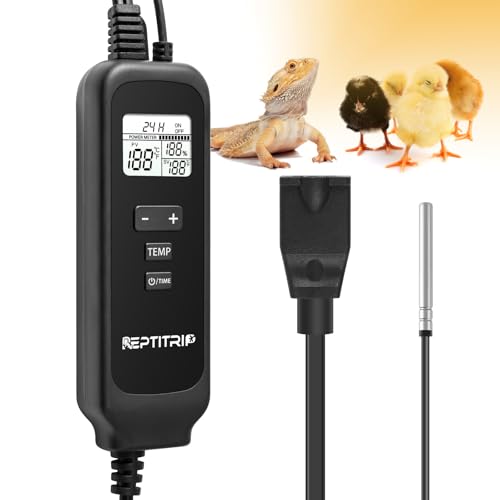
- NOTE: Place the temperature sensor in the reptile's basking area(or hot zone). If the current...
- This Reptile Dimming Thermostat Features a timer function, allowing the heat device maintain a...
- Reptile heating devices compatibility: heating mats, daytime heat lamps, infrared heat lamps, night...
⚪ Alternative 2: REPTITRIP Reptile Thermostat
Best for: Budget-minded keepers running a heat mat or single bulb who want basic on/off or dimming control without paying for extras.
Key specs: Reptile thermostat | Probe-based sensing | Digital display | Check listing for wattage and range
Where it beats the main product: REPTITRIP tends to undercut on price, so if you just need a probe and a set point, it can get the job done for less.
Where it falls short: It leans more toward simple switching than the CAVACHEW’s PID dimming, so you lose the smoother heat curve and the bulb-life benefit that comes with it.
If your setup stays under 300W and tops out at 122°F, the CAVACHEW is the one I would grab, since the PID dimming and memory function are genuinely useful at this tier. Go with the REPTIZOO if you need more headroom or a wider range for hotter basking species, and pick the REPTITRIP only if you want the simplest possible probe-and-set-point controller and do not care about dimming.
How It Actually Performs
Temperature Hold and Dimming Response
What surprised me most was how smoothly the PID mode settled in. Instead of the bulb snapping between full blast and off, the dimming eased the output up and down to hold my set point, and I could watch the LED screen track ambient temperature right alongside my target value. Across the 68°F to 122°F range, it never overshot in a way I noticed. The probe reacted quickly to changes near the basking spot, which is exactly what a sensitive probe should do.
Power Output and Load Handling
The 300W ceiling is the number I kept in mind, and for a single heat lamp, heat bulb, or heat mat it was never close to a problem. My bulb drew well under that, so the controller ran cool and calm. The 110V to 240V input also means it is not fussy about your wall voltage. I would not try to run two high-wattage bulbs on one unit, though, because that 300W limit is a hard stop.
Build Quality and Mounting
At 5.9 ounces and 0.8″D x 1.4″W x 3.6″H, the unit is small and light, and the wall-mount style kept it off my table and out of the terrarium. The plastic housing is the honest weak spot. It feels light in the hand and I would keep it clear of splashes or direct heat. The push buttons have a firm click, and the rectangular black body looks tidy once mounted.
Memory Function and Daily Reliability
The memory function is the feature I did not expect to care about until I lost power during a storm. When it came back on, the controller restored my previous settings on its own instead of resetting to defaults. That meant no cold stretch for my reptile while I was away. Combined with the °C/°F display, daily use has been set-and-forget, which is exactly what I want from a thermostat.
Who Is This Reptile Thermostat Best For?
Not every keeper needs the same thermostat, so here is how I would sort the buyers for this one. It comes down to your species, your wattage, and whether you want dimming or just simple switching.
✅ This Is a Great Fit If You…
- You keep a bearded dragon, gecko, lizard, snake, or frog in a single-lamp or heat-mat setup that stays under the 300W max load.
- You want dimming instead of on/off cycling, because the PID mode holds a steadier temperature and the listing says it can extend bulb life.
- Your target temps sit inside the 68°F to 122°F range, which covers most tropical and temperate species.
- You deal with power cuts and want the memory function to restore your last settings automatically, so your reptile is not left cold.
❌ You Might Want to Look Elsewhere If…
- You keep a desert species that needs a basking spot hotter than 122°F, since that is the hard ceiling here.
- You want app control, multiple probes, or a metal housing, because this is a push-button unit with a plastic body and a single probe.
- You need to run several high-wattage bulbs at once, as 300W total is the limit for the CAVACHEW Dimming Thermostat Reptile.
My number one pick here is the keeper with one heat source and a mid-range species who wants smooth dimming and a settings memory without overthinking it. If that is your setup, this one does the job well.
- Efficient & Reliable Temperature Controller: CAVACHEW dimming reptile thermostat adopting advanced...
- Unique Thermostat for Reptiles: CAVACHEW digital thermostat has a memory function, which can restore...
- Multiple Usage: This reptile thermostat can be used for temperature control of heat lamps, heat...
Common Issues & Fixes
A thermostat is only as good as its probe placement and settings, and most of the problems I ran into were fixable without a return. Here are the ones worth knowing before you set yours up.
Temperature Reads Wrong at First
The problem: The LED screen shows a number that does not match what your thermometer says at the basking spot.
My fix: Put the probe exactly where you want to measure, not on the wall or near the glass. Give it a few minutes to settle, since the probe needs time to catch up to the real ambient temperature before you trust the reading.
The Heat Source Never Turns Off
The problem: Your bulb or mat keeps running because the set point is above what the room can actually reach.
My fix: Lower your target inside the 68°F to 122°F range and check that your bulb wattage is enough for the enclosure size. If it still will not hit the number, the room is too cold, not the controller.
Settings Gone After a Power Cut
The problem: You worry the unit reset itself and your reptile is sitting in the cold.
My fix: This is exactly what the memory function handles, so it should restore your last settings on its own. I still double-check the screen after an outage just to be safe.
Overloading the Unit
The problem: You plug in multiple high-wattage bulbs and the controller gets warm or acts strangely.
My fix: Keep total load at or under 300W on a single unit. If you need more heat, run a second controller rather than stacking everything on this one.
Warranty & Support
Warranty details are listed on the Amazon product page, so check there for the exact terms. CAVACHEW says it replies to questions within 24 hours, and since this ships with Prime and free returns, testing it out carries little risk.
- Efficient & Reliable Temperature Controller: CAVACHEW dimming reptile thermostat adopting advanced...
- Unique Thermostat for Reptiles: CAVACHEW digital thermostat has a memory function, which can restore...
- Multiple Usage: This reptile thermostat can be used for temperature control of heat lamps, heat...
Frequently Asked Questions
What temperature range does this thermostat cover?
It holds a constant temperature from 20°C to 50°C, which is 68°F to 122°F. That covers most tropical and temperate reptiles like bearded dragons, geckos, snakes, and frogs. If you keep a desert species that needs a basking spot hotter than 122°F, this one tops out too low for you.
How much wattage can it handle?
The maximum output load is 300W, and it takes 110V to 240V input. For a single heat lamp, heat bulb, or heat mat, that is plenty of headroom. I would not stack multiple high-wattage bulbs on one unit, since 300W is a hard limit.
Does it remember my settings after a power outage?
Yes, and this is the feature I value most. The memory function restores your previous settings automatically once power comes back on, so you are not rushing to reset the range while your reptile sits in the cold. I still glance at the LED screen after an outage just to confirm.
What is the difference between dimming and on/off thermostats?
This one uses PID dimming, which eases the heat output up and down instead of snapping the bulb fully on and off. In my experience that holds a steadier temperature, and the listing says it can improve bulb lifetime. A plain on/off unit is cheaper but swings more.
How do I set it up?
It is a three-step process. Put the probe where you want to monitor, set your target temperature with the push buttons, then plug in your heating device. The LED screen shows ambient temperature and your set value at the same time, and it supports both °C and °F. I found it simple enough to set up in a couple of minutes without reading much of the manual.
Can I use it for a heat mat instead of a lamp?
Yes. The listing names heat lamps, heat bulbs, and heat mats as all fair game. I ran mine with a single bulb, but the same PID control and probe logic applies to a mat. Just keep the total load at or under 300W either way.
My Final Verdict
After living with it, the CAVACHEW Dimming Thermostat Reptile earns a solid spot in my setup. The PID dimming holds a steadier temp than a cheap on/off unit, the 68°F to 122°F range covers my tropical species, and the 300W load handles a single lamp or mat without strain. I would recommend it to any keeper running one heat source for a bearded dragon, gecko, snake, or frog. I would not recommend it for desert species needing more than 122°F.
The 122°F ceiling and plastic body are the real limits, and I will not pretend otherwise. Still, the memory function and smooth dimming make it an easy pick for a single-lamp enclosure, so if that is your setup, it is worth a look.
Ready to Check the Price?
If you keep one heat lamp or mat and want smooth dimming with a settings memory, this controller is a straightforward fit.
As an Amazon Associate I earn from qualifying purchases at no extra cost to you.